Multi URL Opener
How I engineered a high-throughput, multi-platform tab automation engine across Chrome Web Store, Backlinks.tools Web App, and GitHub Open Source—solving browser thread freezing, memory exhaustion, and popup sandboxing for SEO link builders.
The Everyday Bottleneck in SEO Audits
In 2024, while running large-scale backlink intelligence campaigns for Backlinks.tools, my team and I had to inspect 50 to 200 URLs daily—verifying live anchor texts, checking indexing health, and reviewing competitor backlinks.
Opening links one by one manually wasted 20–30 minutes per audit. However, existing open-source web tools and browser extensions were notoriously unreliable:
- ✕ Browser Thread Freezing: Opening 30+ tabs in parallel choked CPU threads and consumed massive RAM, freezing Google Chrome completely.
-
✕
Aggressive Popup Blocking: Browsers restrict programmatic
window.openwithout individual clicks, killing web openers after the first tab. - ✕ Anti-Bot Server Bans: Hitting servers with 100 simultaneous requests in the same millisecond triggered Cloudflare WAF bans and rate limits.
- ✕ Zero Session Persistence: Daily recurring link groups had to be manually copy-pasted every single morning.
Build a Resilient, Queue-Driven Tab Automation Engine
If we introduce an asynchronous pacing scheduler with customizable delay intervals (0.1s to 10s), we can open hundreds of URLs smoothly without memory spikes, bypass browser popup sandboxes, and save link builders hours of daily repetitive clicking.
The Tri-Platform Growth Engine
Rather than building a single isolated tool, I engineered a 3-surface ecosystem to maximize user acquisition, retention, and developer trust.
Chrome Extension
Embedded directly into the browser toolbar. Utilizes native chrome.tabs and chrome.storage.local APIs for zero-friction daily operations, background tab launching, and session persistence.
Backlinks.tools Web Version
Zero-install web utility hosted on Backlinks.tools. Captures high-intent organic search volume for "bulk url opener" and funneling qualified SEO leads into the core SaaS platform.
GitHub Open Source
Full transparency. Privacy-conscious developers and corporate security teams can inspect the source code, verify zero telemetry tracking, and contribute to the parser and feature roadmap.
What Challenges We Faced & How We Solved Them
Building a simple script is easy; engineering a production-grade tool that handles 500+ URLs reliably without crashing Chrome required solving tough browser constraints.
1. Browser Freezing & Thread Starvation
The Obstacle: When a user attempts to open 100+ URLs at once, Chrome spawns concurrent renderer threads, instantly exhausting available RAM and pegging CPU cores to 100%. This caused tab lag, browser freezing, or total browser crashes.
2. Modern Browser Popup Blocker Sandboxing
The Obstacle: To prevent malicious popups, browsers only permit programmatic window openings in direct response to a physical user gesture (click). Any subsequent looped window.open is immediately suppressed.
chrome.tabs.create API with active: false flag to silently load tabs in the background. In the web version, designed a frictionless one-time permission prompt with visual onboarding instructions.
3. Manifest V3 Service Worker Lifecycle
The Obstacle: Chrome Manifest V3 replaced persistent background pages with ephemeral service workers that automatically terminate after 30 seconds of inactivity. A long-running batch of 150 tabs with 2-second delays would be abruptly terminated mid-flight.
chrome.storage.local. Combined with chrome.alarms and event-driven wakeups, the extension re-hydrates its queue state seamlessly, ensuring zero dropped URLs even if the service worker cycles.
4. Zero-Knowledge Local Privacy Architecture
The Obstacle: SEO professionals and enterprise builders routinely paste sensitive internal staging URLs, unreleased product links, and private tokenized dashboards. Any cloud synchronization introduces severe compliance liabilities.
UI/UX Architecture & Screenshots
A screen-by-screen architectural breakdown of Multi URL Opener. Each view is engineered to reduce friction, protect browser stability, and automate high-throughput link workflows.
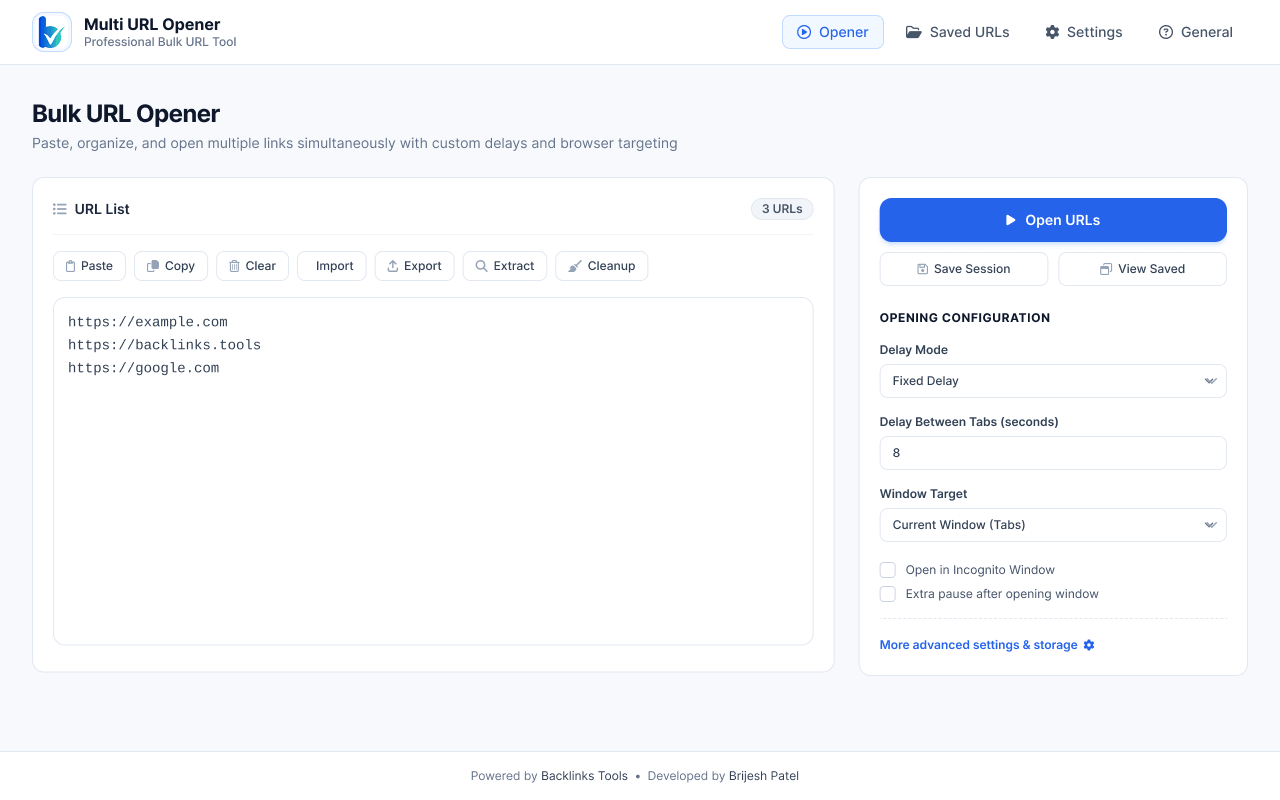
Main Opener Dashboard
Designed for maximum data throughput and zero input friction. A clean, high-capacity textarea accepts raw clipboard dumps—handling up to 500+ URLs at once. The real-time counter immediately parses and validates the link count, with an instant toggle for automatic duplicate removal and whitespace trimming.
Toolbar Quick Action Popup
A core product principle was eliminating context-switching. Link builders and researchers should never have to leave their current active tab to fire a quick batch of 5–20 competitor links. Clicking the extension icon opens a compact, distraction-free popup ready for immediate pasting and execution.
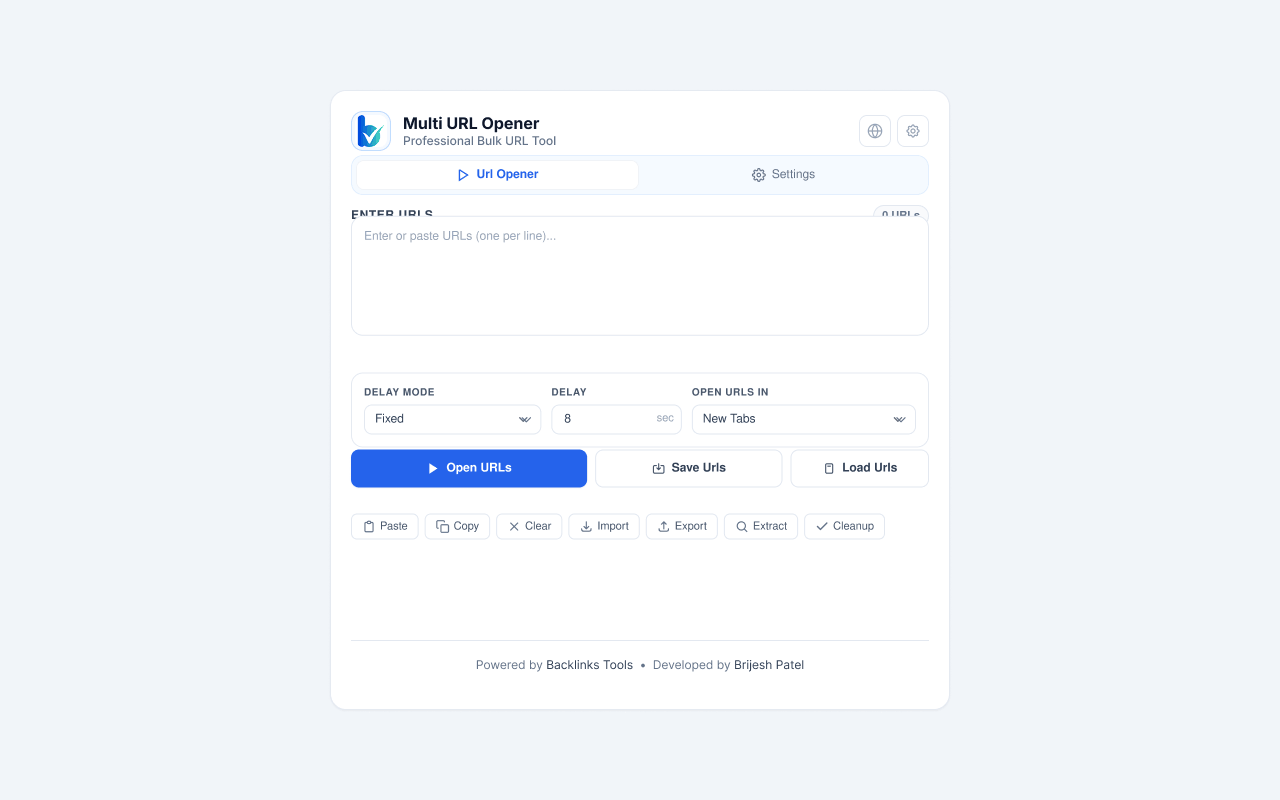
Popup Delay & Mode Controls
Different workflows require different pacing. A quick QA smoke check on 5 links needs 0.1s instant opening, while a massive 150-link backlink audit needs 2.5s delay to prevent server rate-limiting. This popup sub-panel exposes critical delay overrides directly without forcing users into deep option menus.
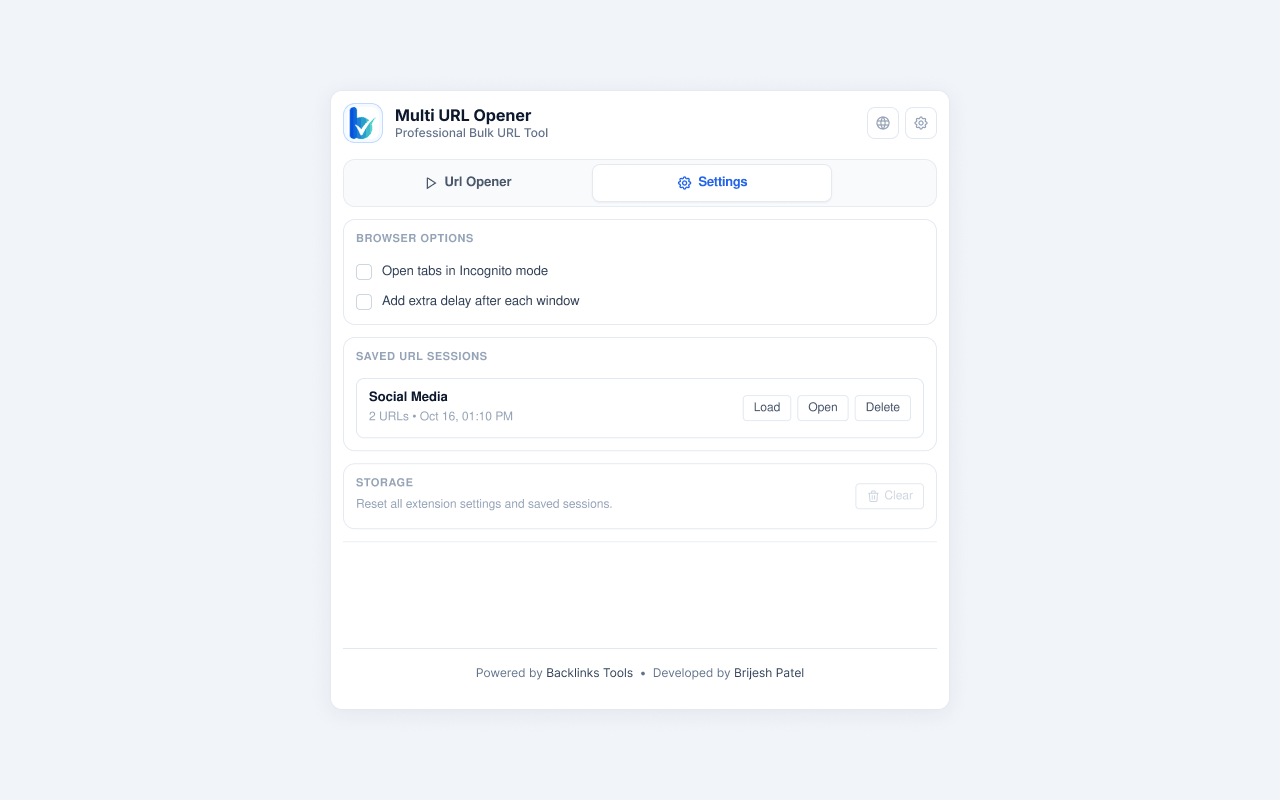
General Preferences & Tab Pacing
Controls how Chrome handles memory and thread allocation during high-volume batch launches. Users can enforce background tab loading so their active window doesn't steal focus, randomize interval delays with micro-jitter to bypass anti-bot heuristics, and specify tab opening order.
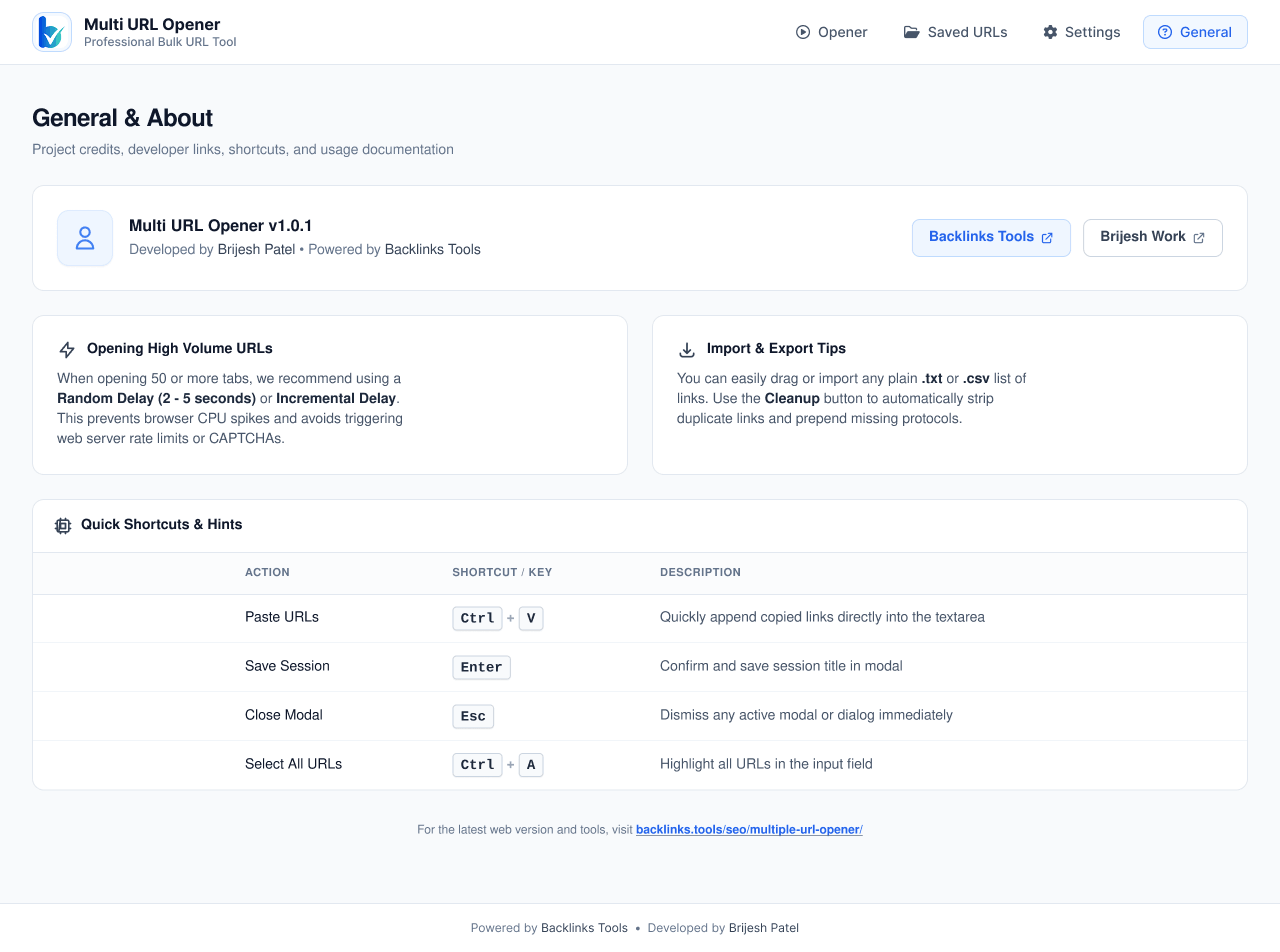
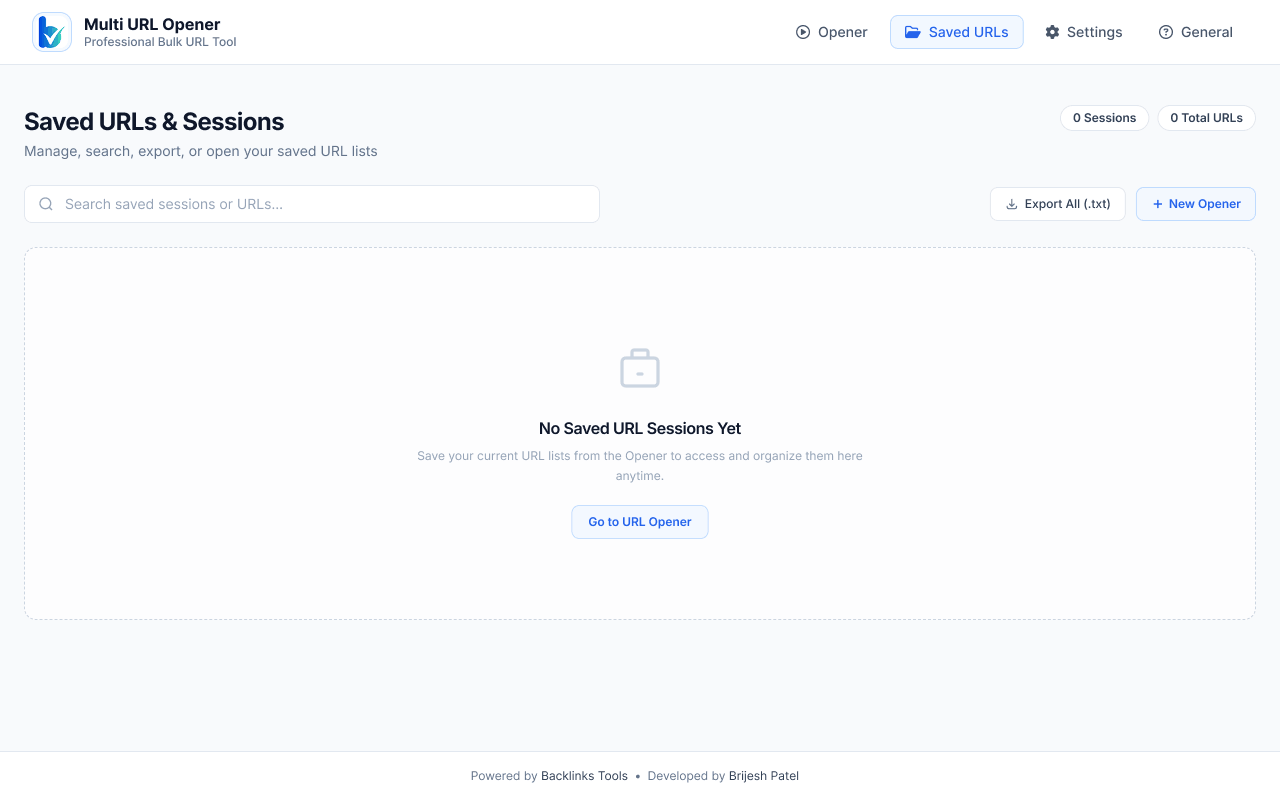
Saved URL Collections
Link builders and SEOs repeatedly check the same batches of competitor domains, indexing targets, and client dashboards every single day. The Saved URLs collection panel turns repetitive copy-paste friction into a single-click launch action stored securely in local device memory.
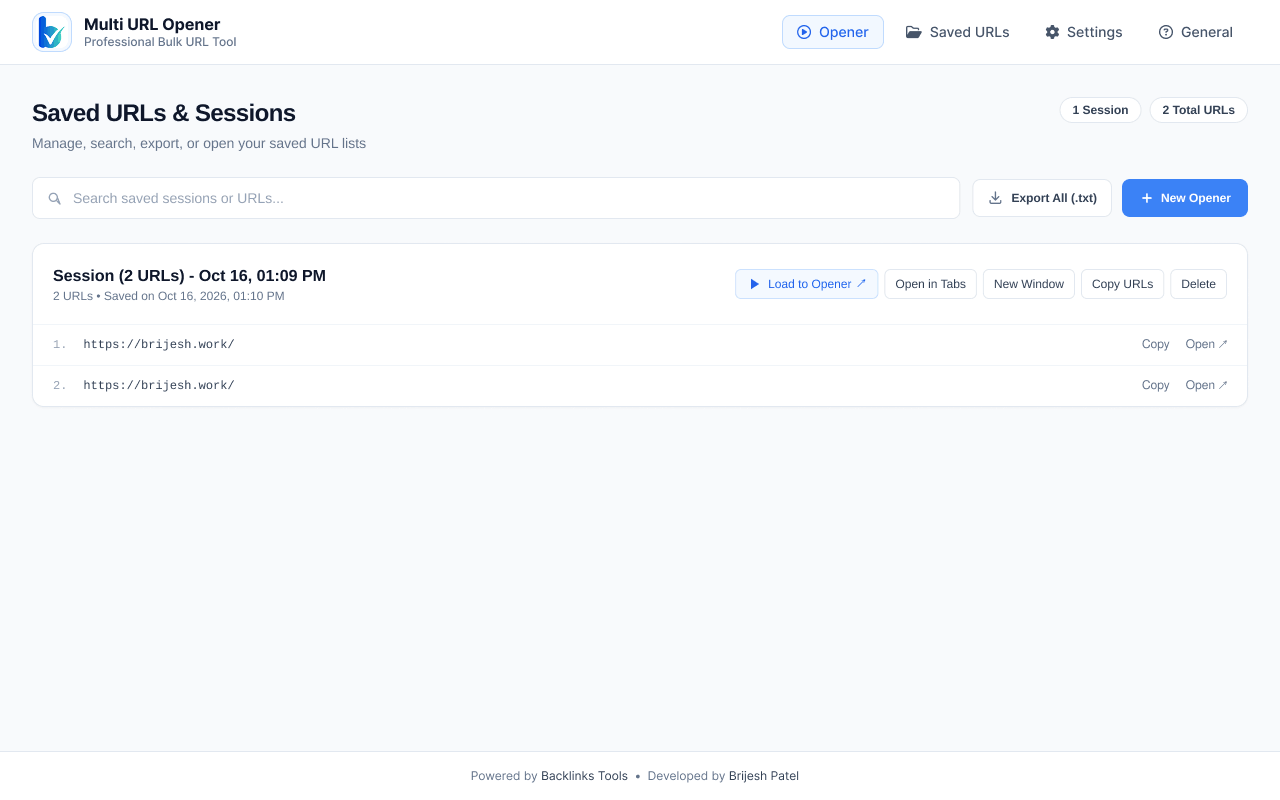
Session Presets & Grouping
Moving beyond isolated URL lists, the Session Manager enables project-level grouping. A user managing multiple clients or research themes can group URLs into dedicated workspace sessions, launching entire multi-tab environments in an isolated window tailored for that specific project.
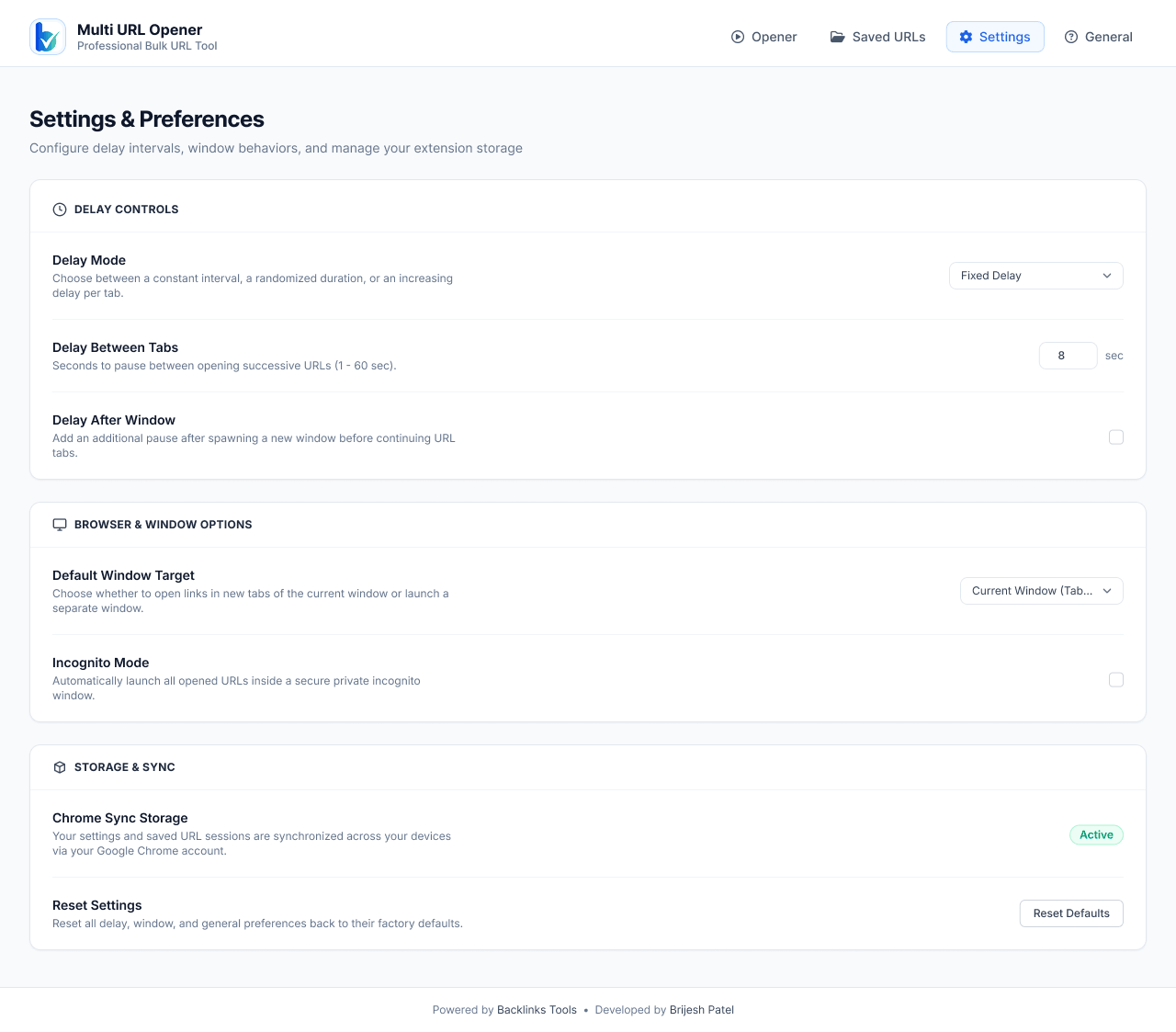
Settings & Advanced Preferences
Built for developer and power-user speed. Provides custom keyboard shortcut bindings (e.g. Alt+Shift+U to trigger instant paste-and-launch), UI theme toggles, input regex sanitization rules, and full JSON export/import for seamless workspace backup across devices.
Key Builder Learnings
Solve Real Operational Friction First
Building tools to solve your own recurring pain point (BacklinksTools SEO audits) guarantees deep domain insight, immediate user empathy, and rapid feedback loops.
Reliability is Feature #1
Users forgive minimal UI, but they never forgive a tool that freezes their entire browser. Prioritizing memory-safe queue throttling turned frustrated users into loyal advocates.
Multi-Surface Funnels Compound Growth
A web tool captures top-of-funnel organic search, an extension retains active daily power users, and an open-source repository earns developer credibility and trust.
Experience High-Speed Tab Automation
Choose the surface that fits your workflow—install the Chrome Extension, test the online web tool on Backlinks.tools, or inspect the open-source code on GitHub.
← Back to All Products